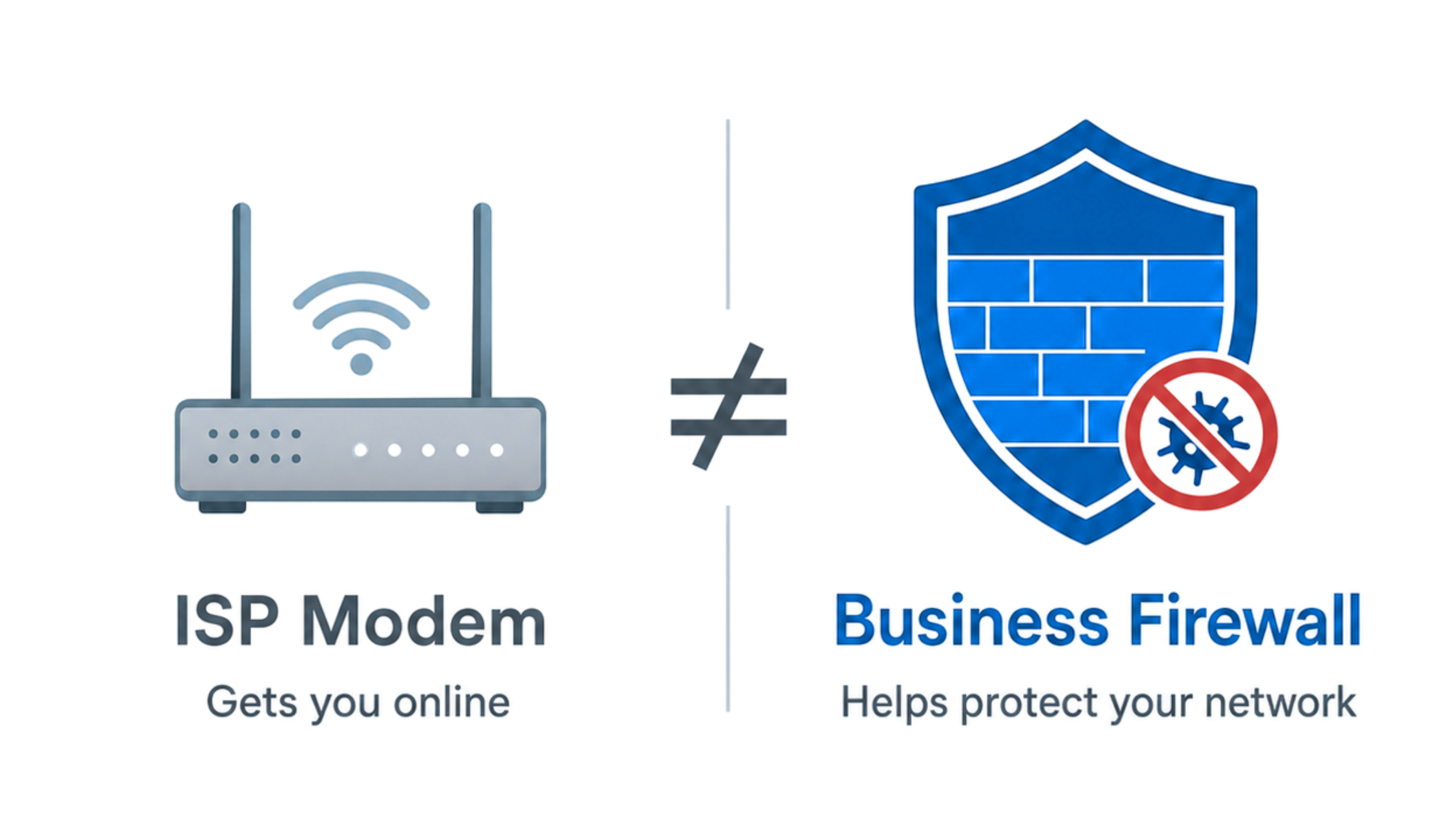
Your Internet provider’s modem gets you online. It does not provide the same protection as a business-grade firewall.
Many businesses assume the device installed by their Internet Service Provider is all they need to protect their network. While an ISP modem or gateway may include basic routing and limited firewall features, it is not designed to deliver the visibility, control, and layered threat protection of a dedicated business firewall. SonicWall notes that an ISP modem is a router with some firewall capability, while a SonicWall firewall adds routing plus more advanced security functions.
A business-grade firewall, such as SonicWall, can help your organization:
- Monitor and control traffic entering and leaving the network
- Block known malicious activity and intrusion attempts
- Apply security rules by user, device, application, or network segment
- Separate employee, guest, camera, VoIP, and other device networks
- Filter unsafe websites and risky content
- Support secure remote access through VPNs
- Provide reporting and logs that help identify suspicious activity
- Inspect traffic more deeply than a basic ISP gateway
SonicWall’s security services can include intrusion prevention, application control, content and DNS filtering, anti-malware, sandboxing, and reporting capabilities, depending on the model and licensed services.
A good comparison is this:
Your ISP modem is like the utility connection that brings electricity into your building.
A business-grade firewall is the security checkpoint that decides what network traffic is allowed in, what is allowed out, and what needs to be blocked.
Both have a role. But they are not the same thing.
Getting online is not the same as being protected online.
Reach out to Bernie Orglmeister at support@skyviewtek.com or call 610-590-5006.